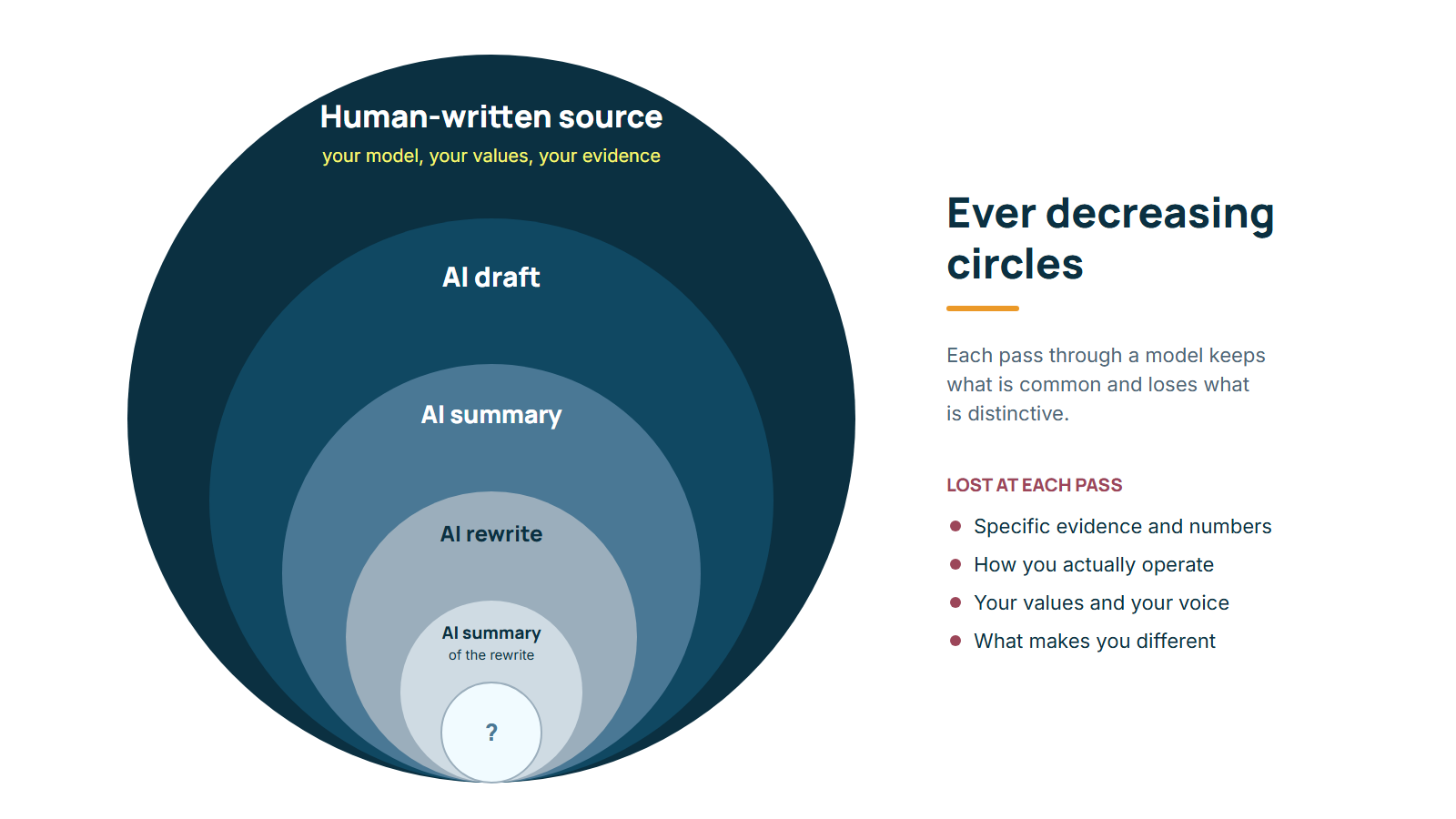
Picture a familiar scene. A bid manager, short of time, asks a generative AI tool to draft the company’s standard answer on social value. A colleague in HR asks the same kind of tool for a new hybrid working policy. A few weeks later, a sales lead loads both documents into another AI tool and asks it to summarise them into a presentation for a prospective client.
Every step looks efficient, and every output reads well. But at no point did anyone write down what this particular organisation actually does, believes or has achieved. The presentation is a summary of a draft, and the draft was itself a prediction of what a typical company might say. The circle has turned twice, and each time it has become a little smaller.
This paper looks at why that matters. It argues that AI is extremely good at summarising, structuring and adapting content, and that it should be used for exactly that, but that the content it works from must be distinctive, human-written and grounded in how the organisation really operates. Otherwise, the question every bid, pitch and policy must answer, “why you?”, has no answer at all.
1. Usage of AI by Businesses in Q4 2026
As 2026 draws to a close, generative AI is no longer an experiment for most organisations. It is part of day-to-day work, even where it is not part of any formal strategy.
In the UK, the Office for National Statistics’ Business Insights and Conditions Survey (fieldwork June 2026, published July 2026) found that around 35% of businesses with ten or more employees were using at least one AI technology, up from around 12% in September 2023. Among businesses with 250 or more employees the figure was 49%, and even among the smallest businesses (up to nine employees) it was 28%. Large language models, the technology behind tools such as ChatGPT, Copilot, Gemini and Claude, were the most widely used type of AI, followed closely by visual content creation.
Global surveys of larger organisations show higher figures still. McKinsey’s The State of AI in 2025 found that 88% of organisations used AI in at least one business function, up from 78% a year earlier, while only around a third had scaled it across the business. Earlier, Microsoft and LinkedIn’s 2024 Work Trend Index reported that three in four knowledge workers were already using generative AI at work, and that most of them were bringing their own tools rather than waiting for their employer to provide them.
The pattern behind these numbers is consistent: adoption is wide, but often shallow. Commentary on the latest ONS figures summarised it as adoption that is widening faster than it is deepening. In practice, the most common uses are the ones that are easiest to start:
- Drafting text: emails, reports, marketing copy, job adverts and, increasingly, bid responses and policy documents.
- Summarising: condensing long documents, meeting transcripts and research into briefings, bullet points and slides.
- Rewriting: changing tone, length or reading level, or adapting one document for a different audience.
- Searching and answering questions across an organisation’s own documents.
Notice that two of these, drafting and summarising, can easily form a loop. Content drafted by AI becomes the input that AI later summarises. That loop is the subject of this paper.
The same trend is visible to the people who receive this content. In UK public procurement, Cabinet Office guidance on AI in bidding (first issued as Procurement Policy Note 02/24 in March 2024) allows buyers to ask suppliers whether AI was used to prepare a tender, and tells procurement teams to expect higher bid volumes and to apply extra due diligence to AI-assisted responses. Buyers have noticed. Many more of the documents in front of them now read the same way.
2. A Quick Dive into How AI Generates Content
To understand the risk, it helps to understand, at least in outline, what a generative AI model is doing when it writes.
A large language model is trained on an enormous body of text: books, websites, articles, code and much more. During training it learns, in great statistical detail, which words and phrases tend to follow which. When you give it a prompt, it does not look anything up or consult a set of facts about your company. It predicts the most plausible next word (strictly, the next “token”, a word or part of a word), adds it to the text, and repeats the process, one token at a time, until the answer is complete.
Three consequences follow from this, and each matters for business writing.
2.1 The output is the plausible average
Because the model is predicting what is most likely, its natural tendency is towards what is typical. Ask it for a quality management statement and it will produce a very good example of what quality management statements usually say. That is useful as a starting template, but it is, by design, the opposite of distinctive. Settings that add randomness can vary the wording, but they do not add knowledge the model never had.
2.2 The model does not know your organisation
Unless you provide it, the model has no knowledge of your operating model, your values as they are lived day to day, your case studies, your pricing logic, your safety record or the decisions your board made last quarter. When asked to write about your organisation without that information, it fills the gaps with whatever is plausible for an organisation like yours.
2.3 Plausible is not the same as true
Models can produce confident, fluent statements that are simply not correct, often called “hallucinations”. In a blog post this is an embarrassment. In a bid response it may become a contractual commitment, and in a policy document it may describe a process your staff do not follow. An auditor, an assessor or a tribunal will judge the organisation against what the document says.
None of this makes generative AI a poor tool. It makes it a tool with a particular strength: turning information it has been given into well-structured, readable text. The question is where that information comes from.
3. RAG as a Solution to Ensure Your Content Is Used as the Source
Retrieval-augmented generation, usually shortened to RAG, is the most widely adopted way of making a general-purpose model work from an organisation’s own material rather than from its general training.
In simple terms, it works in three steps:
- Prepare: the organisation’s documents are split into passages and indexed according to their meaning, so that relevant passages can be found even when they do not share the exact words of a question.
- Retrieve: when a request is made, the system finds the passages most relevant to it.
- Generate: those passages are given to the model with an instruction to base its answer on them, and only on them, ideally showing where each point came from.
Done well, RAG brings real benefits. Answers reflect the organisation’s own content rather than the internet’s average. They can be traced back to a source document. They stay current, because updating the documents updates the answers without retraining any model. And the scope for hallucination is greatly reduced, because the model is summarising material in front of it rather than recalling from memory.
3.1 RAG in presentations
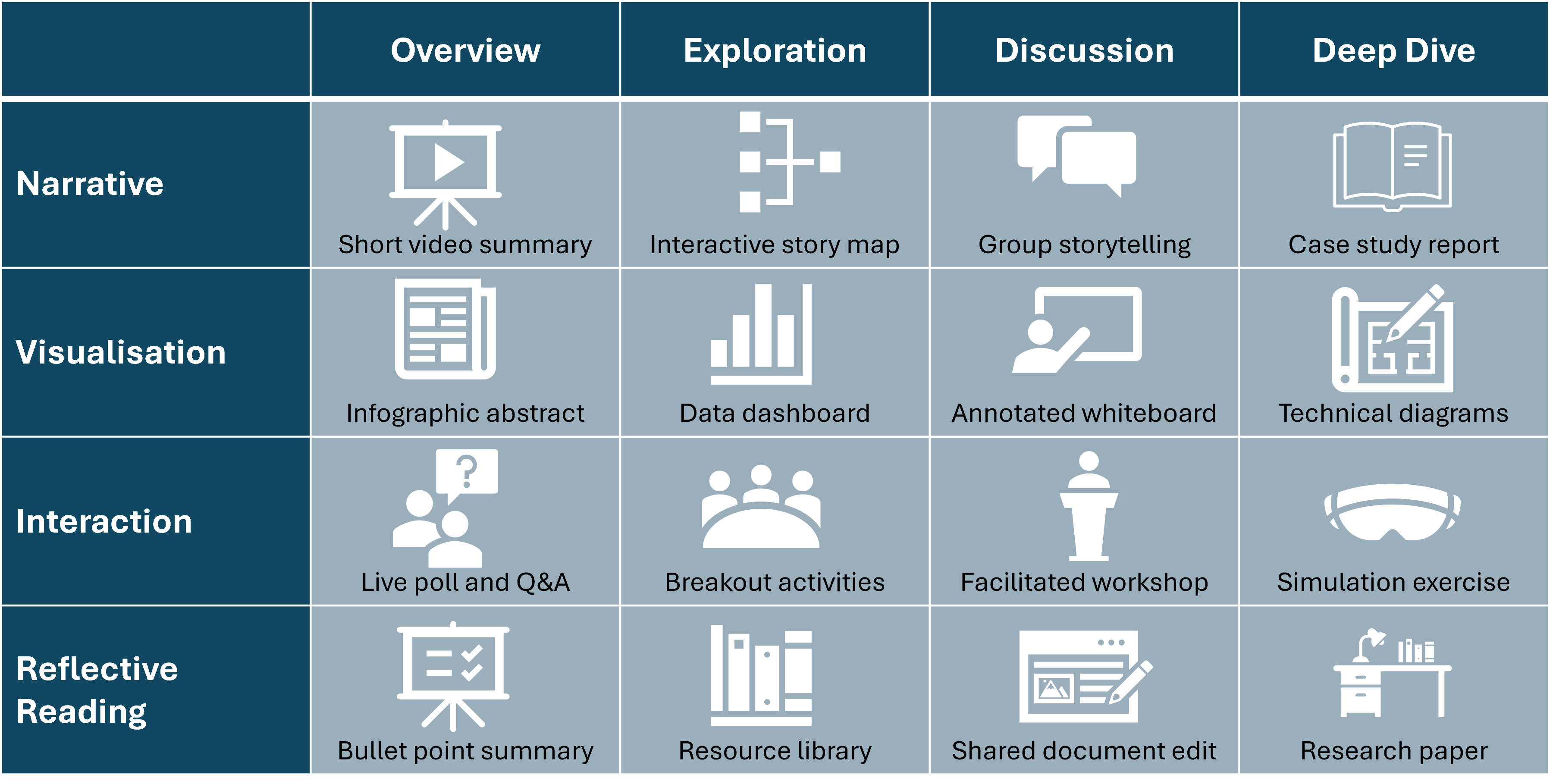
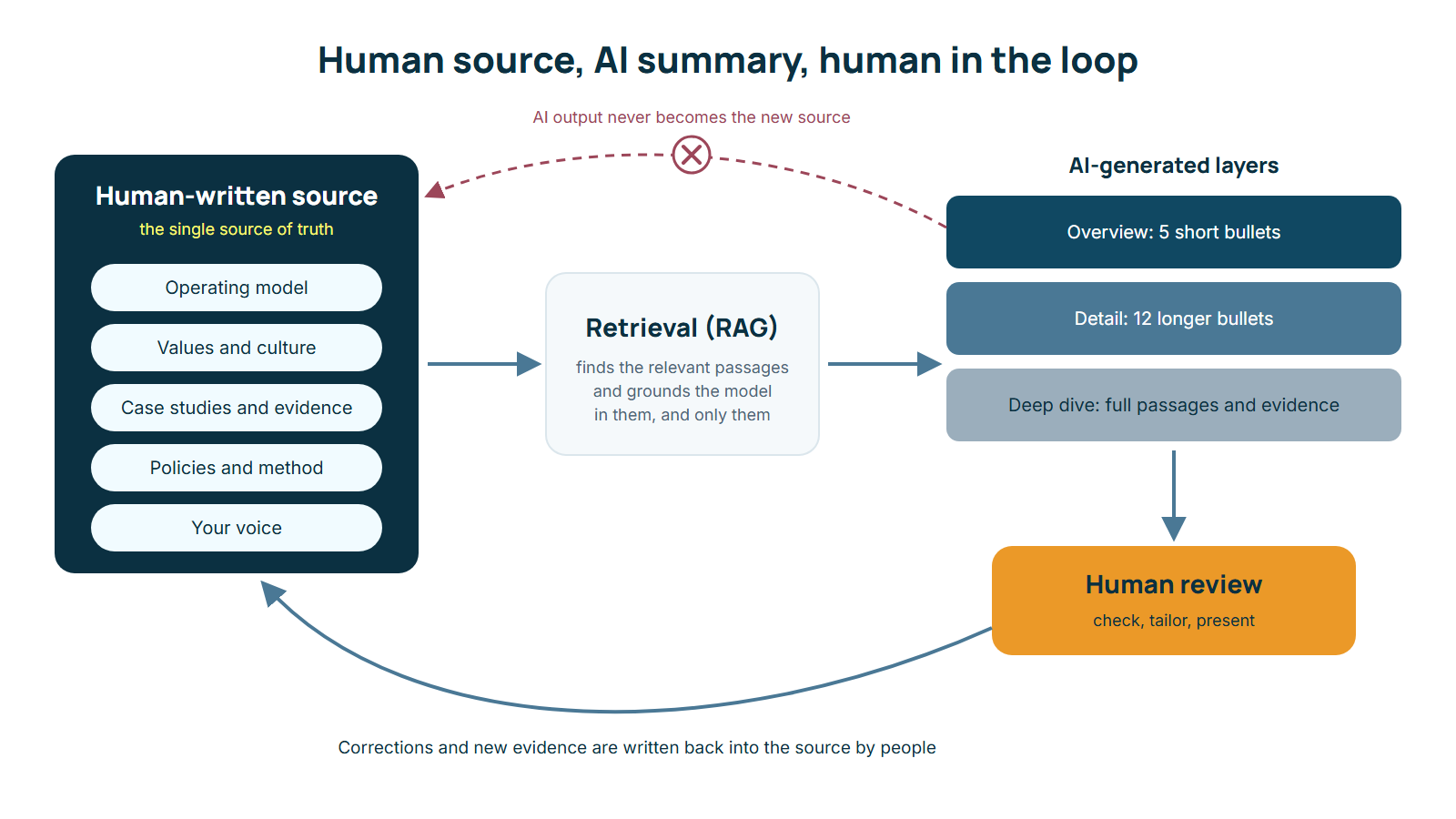
slideAcross uses this approach to build presentations. Source material, such as a proposal, a policy or a product document, is retrieved and used to generate slide content at different levels of detail to suit each layer of a multilayered presentation: perhaps five short bullets at the overview level, twelve longer bullets one layer down, and fuller passages and evidence beneath that. The presenter can then move between those levels live, depending on the audience in the room. Every layer is drawn from the same source, so the overview and the detail never contradict each other.
3.2 What RAG does not solve
RAG answers the question “where did this content come from?” It does not answer the question “was the source worth saying?” A retrieval system is faithful to what it is given. If the source is distinctive, specific and true, RAG will carry those qualities into every summary. If the source is generic, RAG will reproduce generic content, now with the added authority of appearing to come from the organisation’s own documents.
In other words, RAG makes the source more important, not less.
4. The Pitfalls of Using AI-Generated Content as Your Source
When the source documents were themselves written by AI, the problems in section 2 do not go away. They become embedded in the organisation’s knowledge base, and every later summary inherits them.
4.1 Everyone starts to sound the same
A study by Anil Doshi and Oliver Hauser, published in Science Advances in 2024, asked writers to produce short stories, with some given access to ideas from a generative AI model. Individually, the AI-assisted stories were rated as more creative and better written, especially for less experienced writers. Collectively, however, they were more similar to each other. The authors described this as a social dilemma: each writer is better off, but together they produce a narrower range of content.
Apply that to a competitive tender. If five bidders each ask similar models for their approach to social value, mobilisation or continuous improvement, the evaluator receives five polished, well-structured and remarkably similar answers. Each one scores adequately, and none of them stands out. Evaluation criteria reward evidence, specificity and relevance to the buyer, which are precisely the things a model cannot supply on its own.
4.2 A summary of a summary
Every summary is a choice about what to keep and what to leave out. A model summarising a document tends to keep the points that seem most central and typical, and to drop the details that seem peripheral: the specific figure, the unusual method, the named client, the exception to the rule. Those details are often what made the original distinctive.
When the source was a human-written document, a single summary loses some of this detail, and the original is still there for anyone who needs it. When the source was already an AI draft, the distinctive detail was never there in the first place, and each further summary, rewrite or translation reduces the content towards a common core. This is the ever decreasing circle.
4.3 A lesson from model collapse
Researchers have studied a related effect at a much larger scale. In a 2024 paper in Nature, Ilia Shumailov and colleagues showed that when AI models are trained repeatedly on content produced by earlier models, the “tails” of the original data (the rare, unusual and specific material) progressively disappear. They called this “model collapse”. Over successive generations, the models’ output drifted towards repetitive, narrow and eventually nonsensical text. The authors concluded that genuine human-generated content will become more valuable as AI-generated content spreads.
An organisation’s document library is not a training set, and RAG does not retrain a model. But the principle carries across: a knowledge base that feeds on its own AI-generated output steadily loses the rare and specific material that distinguished it. In a business, that rare material is your competitive advantage.
4.4 Policies that describe someone else
Policies and procedures are not just documents. They are statements of how an organisation actually behaves. An AI-written policy describes how a typical organisation might behave. Staff may not recognise it, it may promise processes that do not exist, and it may omit the things that are genuinely specific to the business, such as its sector, its risks and its history. When an auditor, a certification body or a buyer compares the policy with practice, the gap becomes visible.
4.5 Losing the thinking
Writing a policy or a bid answer from scratch is uncomfortable because it forces decisions. What exactly is our approach? What will we commit to? What evidence do we have? When AI produces the text, those decisions can be skipped without anyone noticing. The organisation ends up with a document but without the shared understanding that writing it should have created.
4.6 Transparency and trust
Buyers increasingly ask whether AI was used, and readers are becoming good at recognising its fluent but generic style. Content that reads as machine-written invites a simple question: if the organisation did not take the time to write this, how much did it think about it?
5. The Role of the Human Source and the Human in the Loop
The answer is not to avoid AI. It is to be clear about which part of the work belongs to people and which part AI does best. A useful way to think about it is that humans own the source, and AI works downstream of it.
5.1 The human source
A strong human source is not necessarily long or beautifully written. What matters is that it contains things only your organisation could say. In practice that means:
- Operating model: how work actually flows, who does what, and what makes your delivery different.
- Values with evidence: not just the words on the wall, but examples of decisions where those values made a difference.
- Case studies with numbers: named outcomes, timescales, measures and lessons learned.
- Positions and boundaries: what you will and will not do, and why.
- Your voice: the language your people and clients actually use.
AI can help people write this material. It can interview a subject-matter expert, challenge vague claims, suggest structure and tidy the prose. The distinction that matters is between AI-assisted content, where the substance comes from people and AI improves its expression, and AI-originated content, where the substance comes from the model.
5.2 The human in the loop
Once a strong source exists, AI can do what it does well: summarise it, structure it and adapt it for different audiences and levels of detail. The human in the loop then has three jobs:
- Check: confirm that what the AI produced is accurate and faithful to the source.
- Tailor: adapt the emphasis for the specific audience, buyer or situation.
- Feed back: when something is wrong or missing, correct the source, not the summary. New evidence, new case studies and lessons learned should be written into the source by people, so that every future summary benefits.
The one rule that keeps the loop healthy is that AI output never becomes the new source. Summaries are disposable and can be regenerated at any time. The source is the asset.
5.3 The presenter as the final loop
In a presentation, the person in the room is the last and most important human in the loop. A multilayered presentation built from a strong source gives that person the freedom to respond: to stay at the overview for an executive audience, to go deeper for a technical one, and to bring in evidence when a question demands it. The AI has done the preparation, but the judgement about what this audience needs, today, remains human.
6. Conclusion and Recommendations
Generative AI has made it almost effortless to produce text that reads well. That is exactly why reading well is no longer enough to stand out. When everyone can generate a competent answer, the advantage moves to the organisations whose answers contain something that cannot be generated: their own evidence, methods, values and voice.
The perpetual cycle of AI drafting content and AI summarising it is easy to fall into and hard to notice from the inside. Each turn produces something polished, and each turn leaves the content a little more generic. Breaking the cycle does not mean giving up the efficiency of AI. It means putting that efficiency in the right place.
We recommend that organisations:
- Treat source content as a strategic asset. Bid libraries, policies, case studies and method statements deserve the same care as any other asset that wins business.
- Write the substance yourselves. Use AI to help people express what they know, not to invent what they should know.
- Use AI downstream. Let it summarise, structure and adapt human-written sources for different audiences and levels of detail.
- Never let AI output become the source. Keep summaries disposable, and make corrections in the original.
- Ground your tools with RAG, and choose tools that show which source each point came from.
- Give every source document a named owner and a review date, so that it stays true to how the organisation actually operates.
- Apply the competitor test: if a competitor could put their name on a paragraph without changing a word, rewrite it.
- Be open about how AI is used, particularly where buyers ask.
For organisations that do not have the time or capacity to build that foundation themselves, Affirmable, the company behind slideAcross, offers a Content Library Creation service. It produces a human-written library of evidence, case studies, insight and approved messaging that bid teams and AI tools can draw on with confidence.
AI can do the summarising, and it can do it remarkably well. But a summary can only ever be as distinctive as the thing it summarises. The organisations that stand out will be the ones that keep writing their own story, and let AI help them tell it.