<< View all White Papers
1. The Theory of Learning Styles
The theory of learning styles has a long and complex intellectual history. Its foundations can be
traced to early 20th‑century psychological research into individual differences, where scholars
such as William James, Wilhelm Wundt, and Ernst Meumann explored how people vary in their
perceptual and cognitive processing. Later, educational approaches such as the Montessori method
emphasised sensory‑based and hands‑on learning, further shaping the idea that learners engage
with information in diverse ways.
The modern VAK (Visual / Auditory / Kinesthetic) typology began to take recognisable form in
the 1960s, initially within work on reading difficulties and sensory integration. The concept gained
widespread visibility during the 1980s, supported by the rise of learning‑style inventories and the
broader popularity of theories emphasising cognitive diversity. In 1992, Neil Fleming introduced the
VARK model, distinguishing Reading/Writing as a separate modality and cementing the framework
familiar in contemporary discourse.
Although empirical evidence for matching instruction to a single preferred style remains
contested, the broader insight is well‑supported: individuals differ in how they prefer to receive,
process, and interact with information. In classroom environments, this understanding often informs
decisions about instructional materials, media selection, and activity design. Increasingly,
research emphasises multimodal learning, suggesting that learners benefit from encountering
information through multiple channels rather than relying on a single dominant modality.
This evolution - from fixed learning styles to flexible, context‑dependent interaction
preferences - provides a useful foundation for understanding diversity in audience engagement across
both educational and non‑educational settings.
2. Applying the Theory of Audience Modalities Beyond Education
While learning styles emerged from educational psychology, the underlying principle extends naturally
into organisational communication. Individuals (regardless of role) demonstrate distinct audience
modalities: preferences for how information is delivered, explored, and discussed.
Crucially, these preferences do not map neatly to job titles or professional categories. Two
executive leaders may require entirely different approaches: one may respond best to a concise video
summary, another to a data‑rich infographic, another to structured bullet points, and another to an
interactive Q&A format. The same diversity appears in sales teams, operational groups, and
cross‑functional project environments.
Audience modalities therefore offer a more flexible and accurate framework than role‑based
assumptions. They highlight that effective communication depends on aligning presentation structure
with the audience’s preferred mode of engagement—whether that involves narrative, visualisation,
interaction, demonstration, or reflective reading.
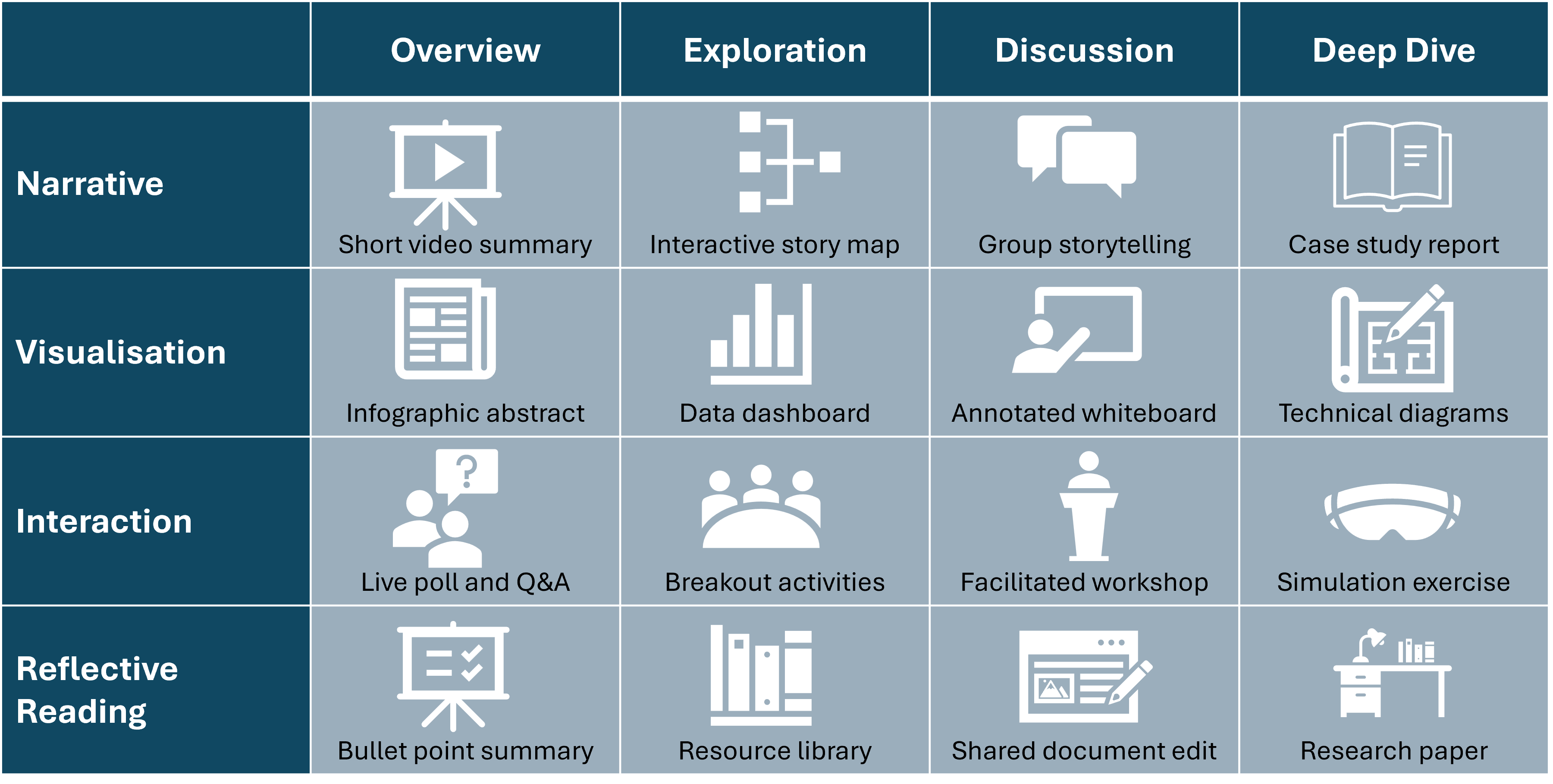
This matrix illustrates how different modalities can be supported at varying levels of depth,
enabling presenters to adapt to diverse audiences within the same session.
3. Considerations Around Inclusion and Accessibility in Live Presentations
Inclusion and accessibility are central considerations when designing live presentations. Unlike
self‑served digital content, live delivery introduces unique constraints and opportunities.
Key factors include:
- Neurodiversity: Individuals may require alternative pacing, reduced cognitive load, or
opportunities to revisit key concepts through different modalities during the session.
- Language and comprehension: Multimodal explanations—such as pairing spoken explanation with
diagrams or examples—support diverse linguistic and cognitive needs.
- Sensory accessibility: Live presentations may incorporate captioned video segments, British Sign
Language (BSL) interpretations for key concepts, or alternative visual representations to
support participants with hearing or visual differences.
- Engagement control: Allowing presenters to shift modality in real time—moving from explanation
to demonstration, or from visualisation to discussion—can help accommodate varied processing
needs within the same audience.
In both educational and organisational settings, these considerations contribute to more equitable
participation and more effective communication.
4. The Limitations of Linear Presentation Software
Traditional presentation tools are built around a sequential slide‑based model. While effective for
structured lectures or formal briefings, this model introduces several limitations when addressing
diverse audience modalities:
- Fixed sequencing: Presenters must follow a predetermined order, even when audience needs
diverge.
- Uniform pacing: All participants receive information at the same speed, regardless of
comprehension or interest.
- Restricted responsiveness: Addressing questions or shifting focus often requires navigating away
from the current slide, disrupting flow.
- Format rigidity: Switching between modalities - such as moving from a video to a diagram to a
live demonstration - can be cumbersome.
- Reduced audience agency: Participants cannot influence the direction or depth of the
presentation in real time.
These constraints are increasingly visible in classrooms, boardrooms, and sales environments where
audiences expect more adaptive, responsive communication.
5. How Adaptable Presentations Can Respond to Audience Needs
Adaptable presentation systems offer an alternative to the linear model by enabling presenters to
navigate content dynamically. Rather than progressing through a predetermined sequence, presenters
can respond to audience cues, questions, and preferences as they emerge.
A defining feature of adaptable systems is the use of multilayered slides. Instead of a single, fixed
representation of a concept, each slide can contain multiple layers of depth, modality, or
explanation. These layers may be:
- Intentionally pre‑structured, allowing the presenter to reveal additional detail in response to
anticipated questions or differing levels of expertise within the audience.
- Generated or assembled in real time, drawing from a prepared library of written content,
examples, diagrams, or explanations to address unexpected questions or shifts in audience
interest.
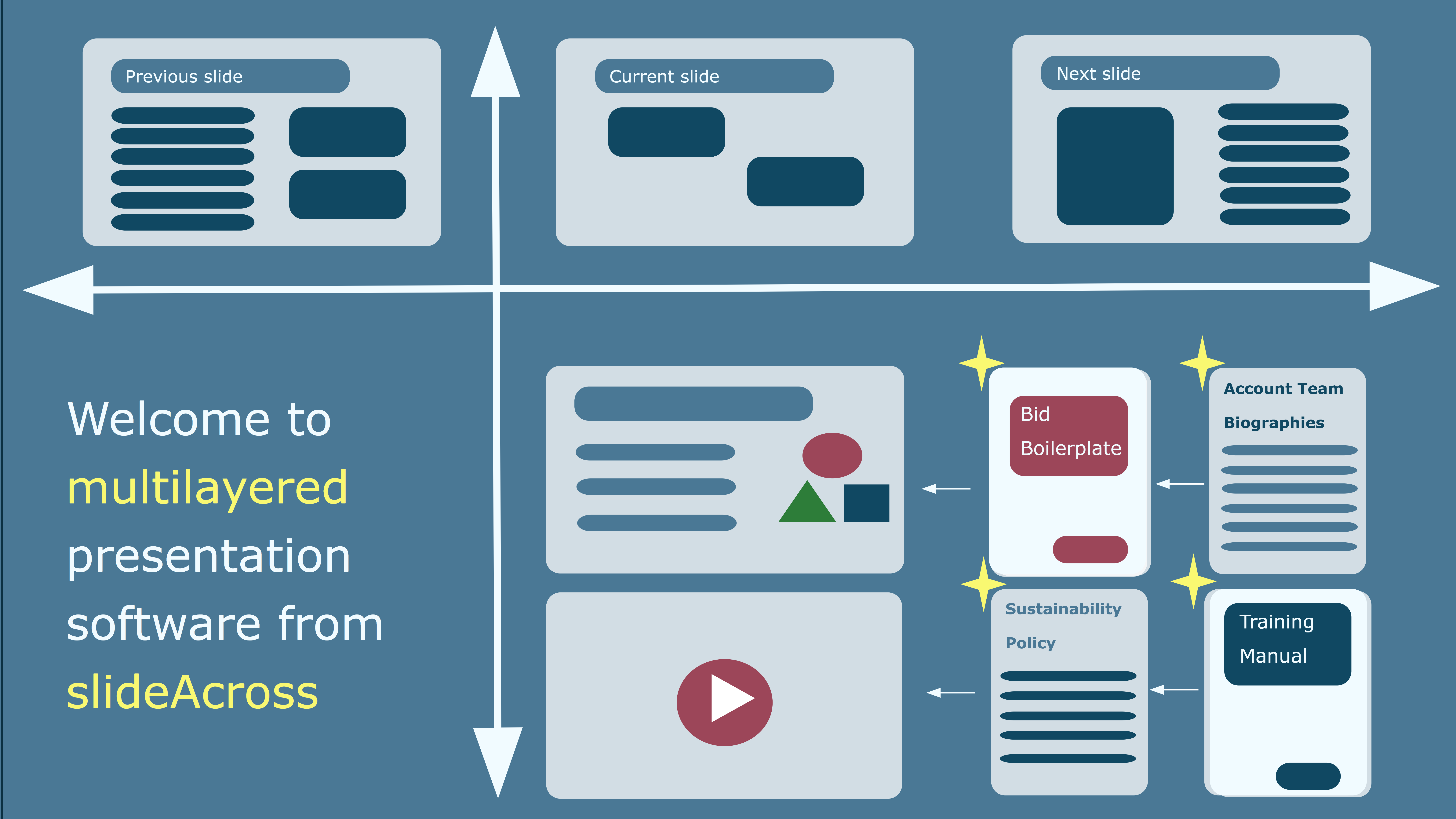
slideAcross is an example of a platform designed around these principles. It structures presentations
as interconnected, multilayered modules rather than sequential slides, enabling presenters to adapt
both the order and the depth of content in response to audience needs.
6. Practical Considerations Around Adaptable Presentations
While adaptable presentations offer significant advantages, they also introduce practical
considerations that educators and organisational leaders should evaluate.
6.1 Presentation Style and Professional Expectations
Non‑linear, conversational delivery can feel more informal than traditional slide decks. In some
contexts - such as formal assessments, regulatory briefings, or high‑stakes executive reviews - this
informality may be inappropriate.
6.2 Presenter Preparedness
Adaptable presentations require deeper familiarity with the material. Preparation must include:
- understanding the full content structure
- anticipating likely audience pathways
- rehearsing transitions between modalities
- preparing concise explanations for each module
6.3 Cognitive Load for the Presenter
The flexibility of adaptable systems can increase the presenter’s cognitive demands. Clear structure,
modular design, and intuitive navigation cues help mitigate this.
6.4 Organisational and Educational Alignment
Institutions may need to consider:
- staff training
- integration with existing digital ecosystems
- accessibility practices for live delivery
- evaluation of pedagogical or organisational impact
7. Conclusion
The evolution from learning styles to audience modalities reflects a broader shift in both education
and organisational communication: a recognition that individuals engage with information in diverse
ways. Linear presentation tools, while familiar and widely used, often struggle to accommodate this
diversity. Adaptable presentation systems offer a promising alternative, enabling presenters to
respond dynamically to audience needs, support inclusion, and enhance engagement.
For educators, sales professionals, and organisational leaders, the central question is not which
modality is superior, but how to design communication environments that respect and leverage
diversity. Adaptable presentations represent one pathway toward that goal.